
Executive Scientific Summary: The MetaSpace Paradigm Shift
1. The Core Paradox: Efficiency vs. Safety
Traditional safety-critical control systems (e.g., SPS, MPC, LSCR) operate under a mathematical "Zero-Sum Game": higher safety guarantees require higher computational complexity (O(N³) or higher). On resource-constrained hardware (ESP32, STM32), this leads to a "Computational Ceiling" where the math intended to save the system eventually kills it via Watchdog Timer (WDT) resets or latency-induced instability.
MetaSpace.bio resolves this by Complexity Decoupling: shifting the computational burden from the Runtime Execution to the Pre-operation Synthesis (Compiler Phase).
2. Deterministic O(1) Runtime Execution
The MetaSpace technology replaces online system identification with Invariant Set Enforcement.
- The Transition: While traditional methods attempt to solve complex linear algebra online to "guess" the system state, MetaSpace utilizes a pre-certified "Logic Lock"—a high-dimensional safety manifold synthesized offline.
- Mathematical Complexity: The runtime check is reduced to a fixed-depth polynomial or iterative evaluation. This ensures a 100% deterministic execution time, independent of system noise, matrix conditioning, or environmental stress.
- The Result: A transition from O(B · N³) (stochastic batch processing) to O(1) (constant-time validation).
3. The Energy Efficiency Gap (100x Advantage)
The energy advantage is not merely "faster code," but a fundamental change in Hardware Duty Cycle Management:
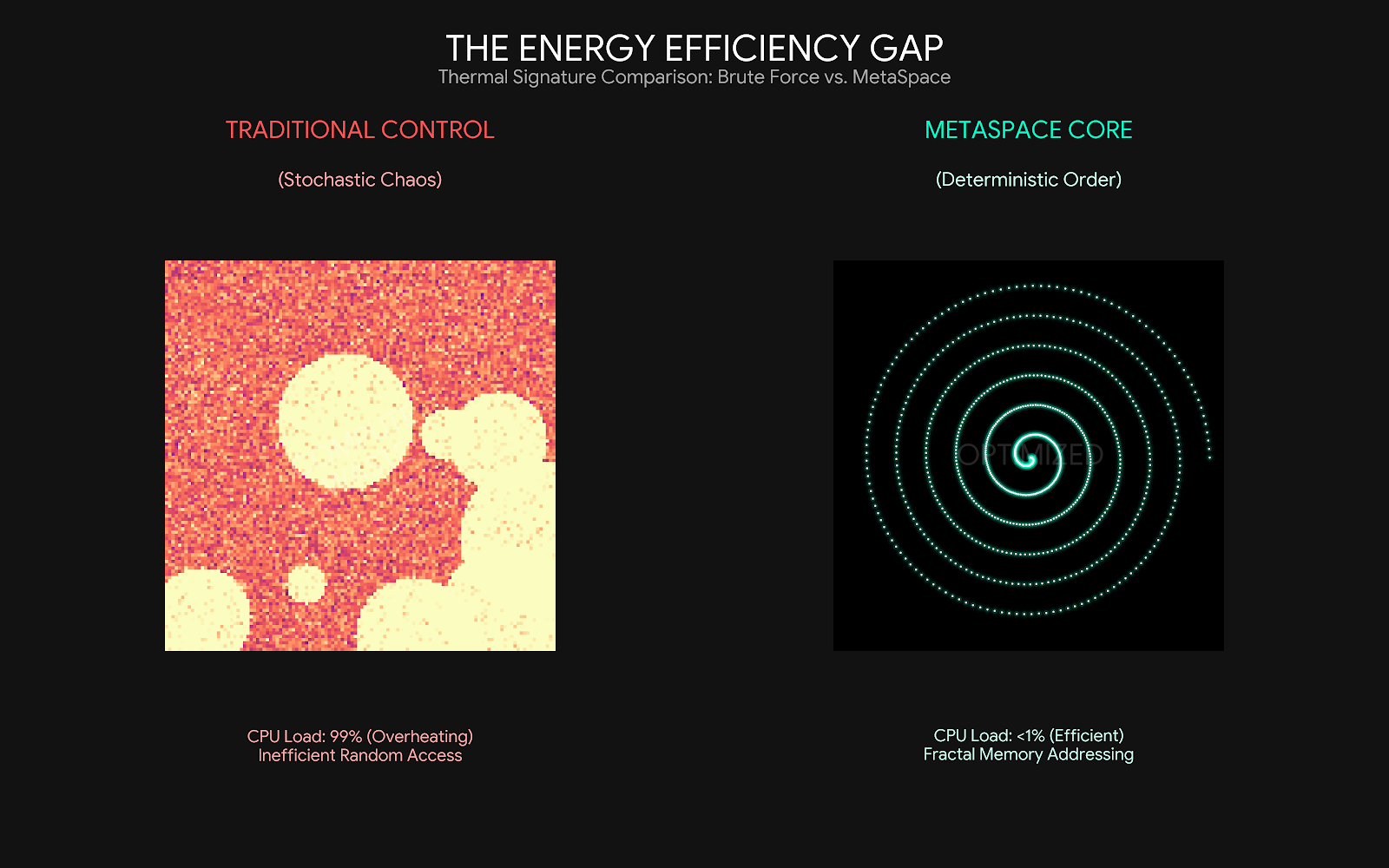
Figure 1: Comparison of duty cycles between traditional and MetaSpace approaches.
- Traditional Approach: High-complexity tasks keep the CPU in a high-power state (Active) for the majority of the control loop. The "window of idleness" is too narrow for deep-sleep transitions.
- MetaSpace Approach: Since the safety check is completed in microseconds, the CPU can spend >99% of the control cycle in Light/Deep Sleep modes (~0.8mA vs 240mA).
- Scientific Metric: This creates a cumulative power reduction of two orders of magnitude while maintaining the same 50Hz/100Hz control frequency.
4. The Synthesis Integrity (Compiler Trust)
The reliability of MetaSpace rests on the Compiler’s Formal Verification capabilities:
- Offline Synthesis: The MetaSpace compiler processes advanced non-linear System Identification theories to map all possible uncertainty manifolds into a compact, pre-verified safety shell.
- Safety Margins: Unlike online solvers that may fail to converge, the MetaSpace Logic Lock is pre-certified. The compiler performs reachability analysis to ensure that if the system stays within the synthesized invariant set, no physical constraint violation is possible.
- The "Black Box" Protection: The proprietary transformation from high-dimensional state-space data to lightweight runtime invariants is the core IP. The machine receives a "Mathematical Essence"—the results of billions of simulations condensed into a few lines of deterministic logic.
5. Conclusion
MetaSpace.bio does not circumvent the laws of physics or mathematics; it optimizes the Information Density of the control loop. By performing the "Heavy Lifting" once during compilation, it enables low-cost, low-power hardware to perform with the mathematical rigor of a supercomputer-driven system.